


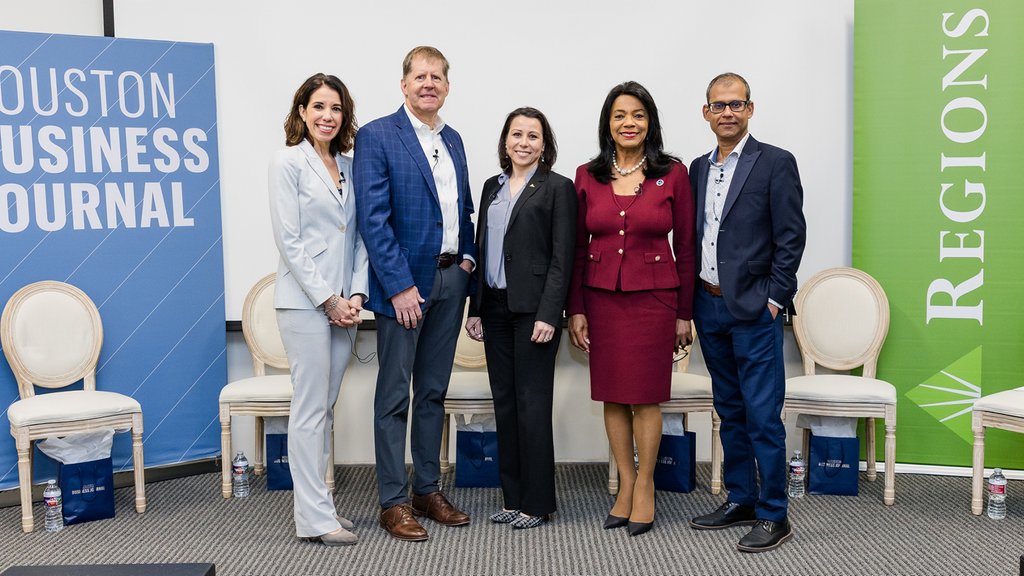
Chariot Energy’s Chief Risk Officer, Krishnan Kasiviswanathan, joined the Houston Business Journal’s Made in Houston panel on April 12, 2026 to talk through the issues defining the next phase of regional manufacturing: workforce pipelines, capital under uncertainty, tariffs, and the long-term reliability of the Texas power grid.
The panel, moderated by HBJ President and Publisher Traci Pelter, brought together leaders across education, banking, and operations. Joining Krishnan on stage were Dr. Margaret Ford Fisher, Chancellor of Houston City College; Caroline Vérot Moore, CFA, Greater Houston Commercial Banking Leader at Regions Bank; Jeff Applegate, Founder and CEO of Texas Injection Molding; and Nubia Perez, CEO and Part-Owner of Gretna Machine Shop. The event was supported by the Greater Houston Manufacturing Association, KHOU 11, Houston Tents and Events, and Prime Systems.
A workforce in transition
The conversation opened on the same problem every Houston manufacturer is wrestling with: a tightening pool of skilled trades.
Dr. Ford Fisher pointed out that the average age of workers in core industrial maintenance roles is about 55, and that demand for new competencies, including automation, robotics, advanced analytics, machining, AI, and cybersecurity, is expanding faster than traditional pipelines can refill them. Houston City College has allocated $10 million to short-term training in manufacturing and high-demand fields, with active partnerships across Apple, Foxconn, and Nvidia.
Jeff Applegate echoed the theme from the shop-floor side, noting that tool and die makers, CNC machine operators, and injection-molding specialists are scarce enough that Texas Injection Molding has had to recruit from outside the region. Applegate also referenced a $60,000 spot electric bill as the kind of event that focuses a manufacturer’s attention on procurement strategy.
Why Texas is “practically an island”
When the conversation turned to long-term power reliability, Krishnan framed the issue in structural terms.
“When it comes to power and electricity, particularly in Texas, the first thing to remember is that we’re practically an island. We have our own power grid which means when it comes to crises, we’re basically on our own,” he said.
He also flagged the scale of the load growth running ahead of the grid. “Our entire electric consumption has grown five-fold. With data centers and crypto-mining, we’re number one or number two in the nation.” Layered on top is weather volatility: “One-in-100-year events are happening every other year. Texas only used to be known for being hot, and all of a sudden we have to worry about winter events as well.”
For commercial customers planning capex around new automation, new facilities, or reshored production lines, that volatility translates directly into procurement risk. Krishnan’s caution to the room was that historical pricing data only tells you so much. “Humans are great managers of yesterday’s risk. What’s going to happen is something we don’t know.”
Buying energy under uncertainty
Krishnan’s recommendation for manufacturers under these conditions is straightforward: stop trying to time the market, and start designing for stability.
“Energy is complex and irrational. When it comes to cost, it’s always good to have predictability through fixed-price contracts using a moving window of pricing, rather than having a floating price. It starts with understanding your consumption. Daytime? Nighttime? Things have changed.”
He noted that the shape of the day has shifted significantly over the past five to ten years. Afternoon peaks that used to drive the highest prices are now being moderated by solar generation, and a facility that runs heavy loads in the afternoon may be in a more favorable position than it would have been a decade ago. The starting point is the same in every conversation: know your load profile, understand the trend, and work with an energy partner that will sit down at the table with you. Chariot’s commercial fixed-rate plans are designed exactly for this profile.
Data, AI, and the path forward
On automation and AI, Krishnan offered both a caution and a reframe.
“Data is the new oil. We need to focus on developing local talent as custodians of good, relevant data,” he said, pointing to Chariot’s position as one of the largest providers of rooftop solar in Texas as a case study in the kind of real, hyper-local datasets students and engineers should be learning from. Our commercial solar buyback program is one place that data shows up directly for business customers.
His closing message to manufacturers worried about the pace of change was that the playbook is the same one good operators have always run. “A lot of things are scary, but don’t worry. Even if it’s a band-aid or duct tape, we’ll figure out something to help you out. AI can tremendously enable and accelerate your growth. It’s when we get behind the curve that things get ugly.”
Houston’s manufacturing economy is still expanding
Applegate closed his portion of the panel with a reminder that Houston’s industrial base is one of the country’s quiet success stories: more than 5,000 manufacturing companies and over 250,000 manufacturing jobs in the region. Caroline Vérot Moore pointed to continued reshoring activity into a business-friendly state, citing Eli Lilly’s $6.5 billion regional investment, supported by a training program San Jacinto College built specifically to meet the company’s needs. Nubia Perez urged business leaders, and their kids, to actually visit a machine shop and see what modern manufacturing looks like.
For our commercial customers, the takeaway aligns with what we are hearing in our own conversations across ERCOT: workforce and infrastructure are the binding constraints on the next five years of Texas manufacturing growth. Energy strategy is one of the few levers operators fully control, and the time to build that strategy is before the next price spike, rather than after it.
We are grateful to the Houston Business Journal and the Greater Houston Manufacturing Association for convening the discussion, and we look forward to continuing the conversation with Houston’s manufacturing community. Operators ready to talk through procurement can request a commercial quote.
Ready to lock in a commercial energy strategy?
If your operation is wrestling with the same workforce, infrastructure, and reliability questions raised on the panel, our commercial team will sit down with you, walk through your load profile, and put real numbers behind a fixed-price plan built for ERCOT.
Source: “Made in Houston: Building the workforce and infrastructure for manufacturing’s future,” Houston Business Journal, sponsored content presented by Regions Bank, April 12, 2026. Read the full panel transcript at the Houston Business Journal.